FRM Fault Assessment
Review of symptoms, diagnostic results, communication status, power-supply information and visible module condition.
BMW Footwell Module faults can affect lighting, electric windows, indicators, mirrors and communication with other body-control systems.
We provide FRM fault assessment, replacement-module compatibility checking, fitting support and BMW coding where required.
Selected modules may be posted for visual and electronic assessment, but the vehicle is normally required for final coding, configuration and functional testing.
Based in Carrick-on-Suir, Co. Tipperary — local BMW coding and nationwide postal module assessment.
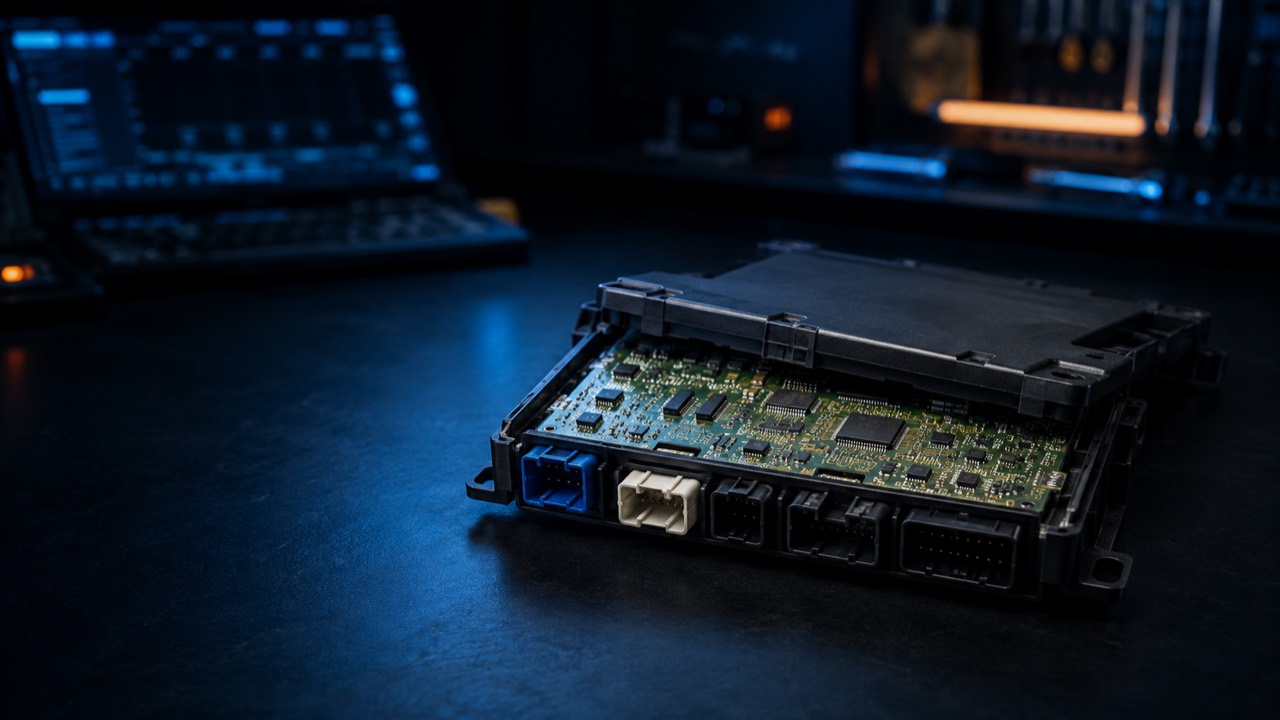
Common BMW FRM3 modules often use a Freescale or NXP MC9S12-series microcontroller with internal flash memory. On supported variants, part of this internal memory may operate as emulated EEPROM.
This means the module does not necessarily contain a separate external EEPROM chip. Internal data recovery requires the exact microcontroller, memory layout and available programming method to be confirmed first.
Internal data recovery may be possible on selected FRM variants after the microcontroller and available programming method have been confirmed.
These symptoms do not automatically prove that the FRM is faulty. Similar problems can be caused by blown fuses, missing power supplies, poor grounds, damaged wiring, water ingress, connector corrosion or CAN-bus communication faults.
Power, ground and communication checks are recommended before replacement. Central locking or remote functions may also be affected on some vehicles when the FRM or body communication network is offline.
Review of symptoms, diagnostic results, communication status, power-supply information and visible module condition.
Visual assessment of water ingress, corrosion, connector damage and circuit-board condition.
Comparison of the original FRM and proposed replacement-module part numbers, hardware versions and module variants.
Advice and fitting support for selected compatible replacement Footwell Modules.
Vehicle-based coding and configuration of selected replacement modules where supported.
Coding based on the vehicle equipment specification where required and supported.
Checking lighting, indicators, windows, mirrors and relevant diagnostic communication after fitting.
Customers may post an FRM for visual assessment and identification after contacting us first. The vehicle may still be required for final coding and testing.
A replacement BMW FRM is not automatically plug-and-play.
Some compatible used modules may restore certain functions immediately. Others may require vehicle coding, equipment configuration, software matching or additional data work.
The FRM is not normally the main engine-start authorisation or immobiliser module, so an FRM fault does not necessarily prevent the engine from starting.
However, lighting, windows, indicators, mirrors and other body functions may remain unavailable or operate incorrectly if the FRM is faulty, incompatible or not correctly configured.
Do not use engine starting alone as proof that the replacement FRM is correct.
The FRM can be posted for module identification, visible-damage assessment and compatibility checking after prior contact.
The vehicle will normally be required where:
Send the registration, model, year, symptoms, fault codes and full diagnostic-scan information where available.
Send clear images of the original FRM label, connectors, visible damage and any proposed donor FRM.
We confirm whether the module can be assessed by post or whether the vehicle is required.
Available replacement, fitting and coding options are explained before additional work is carried out.
A recent BMW FRM replacement restored lighting, electric-window, indicator and remote-locking functions after the original FRM was no longer communicating with the vehicle.
The compatible replacement operated correctly in that particular vehicle without additional coding being required at the time.
This does not mean every replacement FRM will operate without coding. Module compatibility and vehicle configuration must be checked for each individual BMW.
Message us with the registration, BMW model, year, symptoms, fault codes, diagnostic scan information and clear photographs of the original FRM label.
Contact us before posting a module or buying a replacement FRM so the correct assessment route can be confirmed.