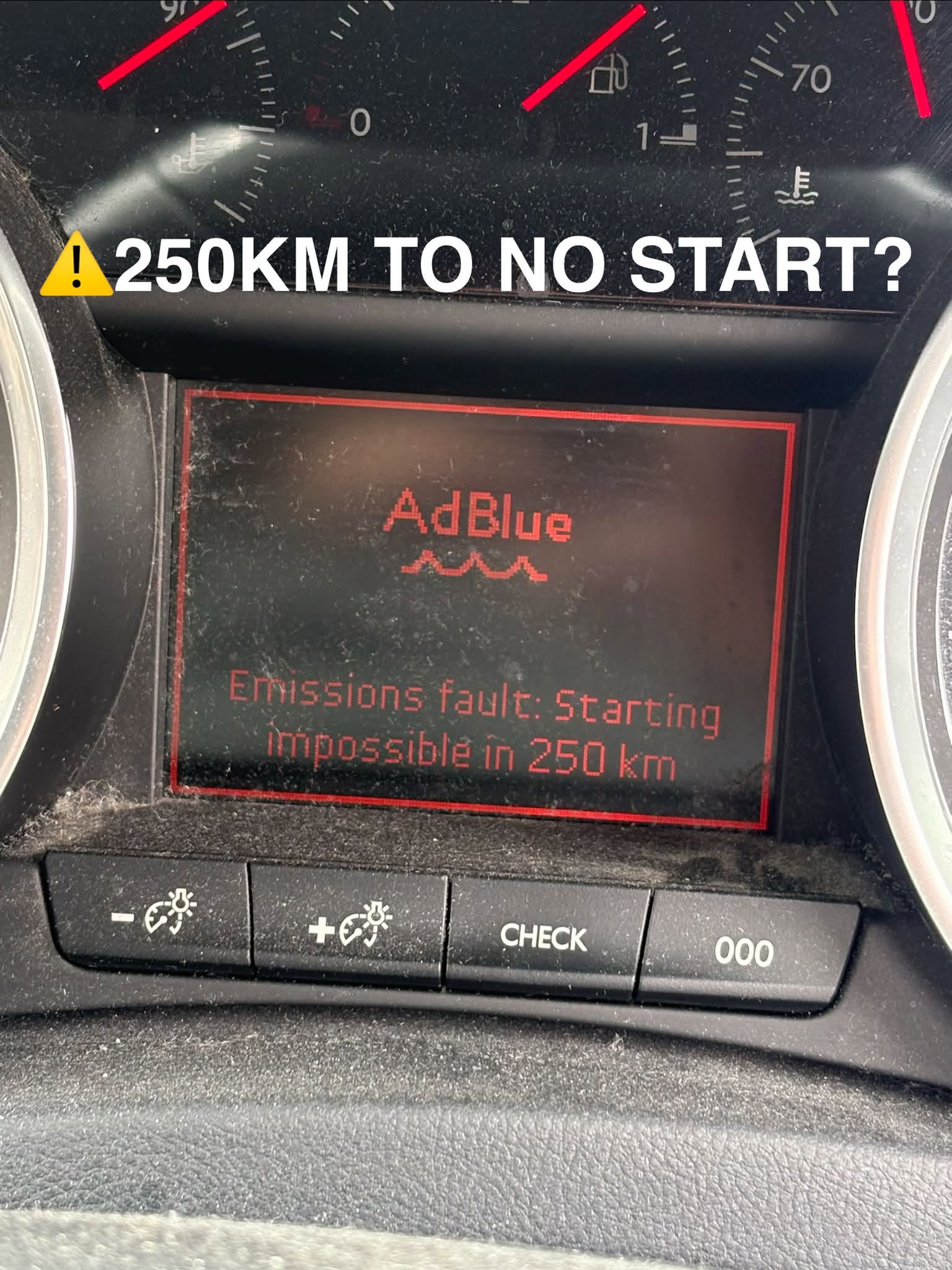
An AdBlue countdown warning should be treated seriously because some vehicles will eventually refuse to start if the SCR fault is not resolved. The message can appear even when the AdBlue tank has been topped up. That is because the system is not only checking fluid level; it is also monitoring quality, pump operation, tank heater, injector dosing, NOx sensor readings, pressure and communication with the SCR control system.
The warning may say emissions fault, AdBlue fault, starting impossible in a set distance, SCR fault or no-start countdown. The exact wording depends on the make and model. When the countdown is already low, leaving the fault until later can turn a repairable issue into a vehicle recovery problem.
Common causes of AdBlue and SCR faults
Common causes include low AdBlue level, poor-quality fluid, crystallisation, blocked injector, failed pump, tank heater fault, NOx sensor fault, wiring problems, software faults or previous repair attempts that did not address the real issue. On some vehicles, one failed component can create several related codes, so the fault list needs to be interpreted carefully.
A proper diagnostic check should read the SCR fault codes, check live data, confirm whether the system can build pressure, inspect temperature and level readings, and consider whether NOx sensor data is plausible. If parts have already been replaced, the vehicle may need adaptation, reset procedures or further investigation before the warning clears.
Repair routes and software support
If the physical fault is clear, repair or replacement of the failed component may be the correct route. If repeated faults remain after sensible checks, AdBlue/SCR software support may be considered for the customer’s intended use. Some emissions-related software work may be suitable only for off-road, motorsport or export use where applicable. The customer is responsible for road legality and emissions compliance.
The key is to avoid ignoring the countdown and avoid replacing expensive parts without evidence. SCR tanks, pumps and sensors can be costly, so good diagnosis matters. A short message with the fault codes and countdown distance can often help decide whether the vehicle needs urgent attention.
What details help with diagnosis
Send the vehicle registration, make, model, year, engine size, current countdown distance, exact dashboard warning, fault codes, and whether AdBlue has recently been topped up. Mention any NOx sensors, tank, pump, heater or injector work already carried out. AdBlue/SCR fault support is available for local customers around Carrick-on-Suir, Clonmel, Waterford, Kilkenny and Tipperary, with ECU bench work where supported.
Do not assume that topping up the tank will reset the warning. If the ECU has detected a quality, pressure, dosing or NOx plausibility fault, the system may continue counting down until the actual cause is addressed. In some cases a correct repair still needs a diagnostic reset or adaptation procedure before the dashboard message clears.
The best time to ask for advice is before the countdown reaches zero. Once a vehicle is in no-start, recovery and access become more awkward. A message with the remaining distance, fault codes and vehicle details can help decide whether the vehicle should be driven, booked in quickly or checked before more parts are ordered.
For garages and owners, it is useful to keep the old fault-code report before clearing anything. SCR systems can log several connected faults, and the order of those faults can matter. A single screenshot of the scan report, plus a photo of the dashboard countdown, often gives enough information to advise the next sensible diagnostic step.
If the vehicle is needed for work, do not wait until the final few kilometres of the countdown. Planning the diagnostic check early gives more room for parts checks, wiring checks or ECU work if required. It also reduces the chance of the vehicle being stranded at the worst possible time.